

- Author: Kate Jones
- Posted: July 29, 2026
CFO Profile > Mandy Binnie | Meridian Energy
The Art of Reinvention
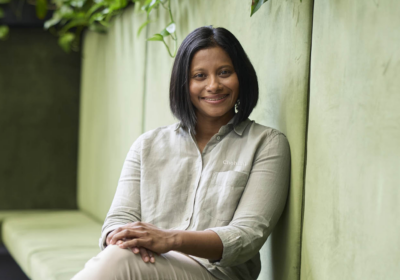
Over a varied and successful career, Mandy Binnie has reinvented herself from CFO to cybersecurity CEO to Chief Digital Officer, putting herself well ahead of the financial technology curve. Now, as CFO of New Zealand’s largest renewable energy generator, she sits at the intersection of two of the most powerful forces reshaping business: the energy transition and the AI revolution.
Fluidity between Technology and Finance
Mandy Binnie’s transitions between finance and tech may look strategic on paper, but she insists they’ve been anything but.
“Almost every career move I’ve made has been somewhat accidental,” she says. “From day one, I’ve always had an eye on technology, and I’ve also had an eye on how to be best prepared for the opportunities that come along.”
Unlike most financial leaders, Binnie’s training was in law. She completed a Master of Law with Honours from Cambridge University and then got her career started as a forensic accountant at Deloitte, before moving to the London Stock Exchange as a regulatory news service (RNS) operations manager.
“I knew that pure finance was never really going to be my home, and so that gave me the ability to go where my interest and curiosity took me,” she explains.
A move to New Zealand came next. Binnie took up positions at Audit New Zealand and the State Services Commissioner, where she held her first role as CFO. She went on to work as CFO of IT services firm Fronde, now Seisma Group, and then switched to COO for four years at the NZX, New Zealand’s Stock Exchange.
At energy company, Z Energy, Binnie switched yet again to become Chief Digital Officer for five years, before starting as Meridian Energy’s CFO in September last year.
“It was already becoming clear to the people who knew me that I was likely to bounce around different business areas,” she says. “Lots of people told me along the way that they thought I was going for roles I was never going to get. I’ve had lots of people say, ‘Why would anyone make you a chief digital officer?’ “But the great thing about finance is you can always return to it – you take that experience from having headed in a different direction and then come back into really interesting roles.”
Modelling financial leaders of the future
Binnie’s regular reinventions may not have been deliberate, but they were propelled by her ambition to learn more about financial technology. Her interest in blockchain led to speaking opportunities at conferences and workshops, and eventually to her becoming a faculty member of technology thinktank Singularity University.
“I was at the NZX, and there were a lot of questions around how blockchain was going to impact the settling of its shares. From there I started getting interested in the technology as a whole,” she says.
“I was speaking to people at a conference about it and one of the organisers recommended me to Singularity University, who at the time were doing a New Zealand conference. I spoke at that, they liked what they saw, and they asked me to go international with them. It was another happy accident.”
For Binnie, the future of finance is inextricably intertwined with technology, whether it’s through blockchain or AI.
“I firmly believe the CFO role is going to have to change and change a lot,” she says. “You now need to be across technology and business to do the role of CFO, and I’m genuinely interested in where those roles will cross over. Technology and finance are getting closer and closer, but interestingly it’s more because of changes in technology than changes in the finance area.
“My sense is it’s almost splitting the profession into those who are saying, ‘this is exciting, let’s get after it and see what can happen’ and those who are working to a timeline of when it’s forced on them.”
She believes that the problem posed by the deepening connection between finance and tech is the training of future industry leaders.
“We’re used to managing teams of people to do things. Now, we’re getting to the stage where we’re going to be managing teams of people and AI or other technologies to get the same things done. That leaves a significant people management problem for us as well, which is how do you train people?” she says.
“How do you bring people through? How do you give them experience if a lot of our standard skills are now being done by technology, whether by AI or something else? How do we maintain within the profession the ability to train people well, and to give them the experience that I got as an auditor, and then through to the operations of businesses? How do they get a sense of how a business works when maybe we don’t need so many of those processes? It’s a real problem for the profession to solve.”
Green energy frontier
Since starting as CFO at Meridian Energy, which generates approximately one third of New Zealand’s electricity entirely from renewable sources, Binnie’s main objective has been learning and listening.
“What I found out is Meridian’s not really one business, it’s more like four businesses merged together. That has meant there’s been a lot to learn in each of those areas, so getting to know the people and the business was my number one priority,” she says.
AI has become an invaluable tool in Binnie’s kit – from a sounding board for ideas and thoughts, to deep finance processes. On the flipside, the AI industry needs a reliable supply of power to fuel its energy-hungry data centres, and renewable companies are in pole position.
“New Zealand as a whole is very strongly positioned – it’s not just Meridian, New Zealand’s electricity system is highly renewable, and so we are seeing interest from AI companies,” she says.
As the world continues to move from fossils fuels to renewables, the energy industry is undergoing is own major transition. Meridian already operates seven hydro power stations and eight wind farms and generates enough renewable electricity to power around 1.4 million homes each year. But the company has ambitious plans to invest around $2b over the next few years and expand its renewable generation portfolio with more wind farms, solar farms and batteries.
“We’re at the early stages of a huge build out of renewable electricity. The challenge is balancing the new demand that we’re trying to attract into New Zealand, with the need to provide electricity that‘s affordable and secure for our existing Kiwi customers,” Binnie says.
As the demands placed on CFO rise, Binnie says it is always important to remember the human element of the role.
“We should stop thinking about the CFO as leader of a finance team and instead as part of an executive team that runs a business. So, as we run those businesses through high change environments, how do we wrap around each other and keep our people sane and healthy and together?”
“That’s the thing that has enabled me to do my best work, and also what probably means the most to people as we move forward. None of us are in this on our own. We’ve got to be in it together.”
Related Posts